



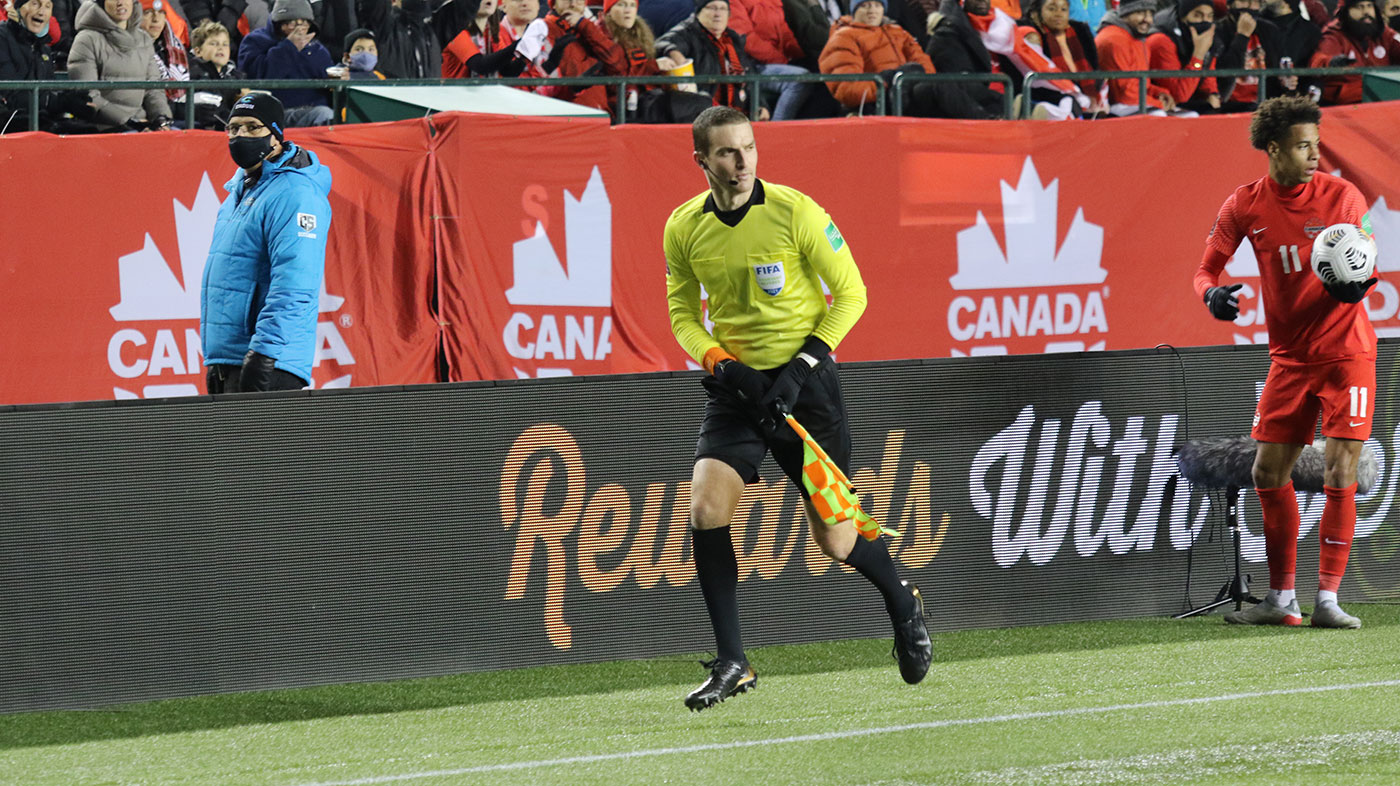
The history of soccer’s offside rule and where it’s heading
(Updated October 1, 2026: This article now includes recent offside clarifications, semi-automated offside technology and the Canadian Premier League’s 2026 daylight trial.)
The offside rule in soccer is integral to the sport’s framework. In the IFAB Laws of the Game, the offside rule is known as Law 11. Without the offside law, teams could leave attackers near the opposition goal and simply heave long passes from one end of the field to the other. The incentive to weave skillfully through opposition defences with an artful short passing game would diminish. Attacking forwards would camp out near the opposition goal, waiting for a long ball pass.
The battle for midfield supremacy would lack the type of build-up fans love to see. Despite all these reasons for the offside law, some still feel it should be abolished. Many fans hate to see marginal offside calls ruin a great goal. However, this law’s evolution has done more to improve the sport than it has been given credit for.
Early years of offside and the first FA laws of the game 1863
In the 1800s, many different rules governed football. Some clubs played football without an offside law; others used one of its various interpretations. Things started to change in 1863 with the birth of the Football Association in London, England. In 1863, the FA decided to codify a strict offside rule in the laws of the game. The 1863 law treated attackers ahead of the ball as offside.
If the ball was kicked forward past a teammate further down the field, that player couldn’t play it. They had to wait until the other side kicked it or an onside teammate could play it. This strict interpretation did not apply to goal kicks, for obvious reasons.
First changes to the offside law 1866
The strict offside law started changing in 1866 with the introduction of the three-player offside rule. This gave players more leeway to take up an advanced attacking position. It opened up the game offensively for downfield passes, helping to spread out the players. As long as the receiver had three opponents nearer the goal line, they could receive the pass.
If they were in an offside position, they weren’t allowed to prevent another player from touching the ball. Proposals included reverting to the strict offside law, implementing a one-player offside rule, or even abolishing the offside law altogether. However, the three-player offside law remained intact well into the next century.
Offside called when ball played rather than when received 1873
In 1873, the law was amended to make explicit that offside is judged at the moment the teammate kicked the ball. An attacker who was onside at that moment could therefore continue a forward run while the ball travelled without becoming offside simply because of their later position. The amendment helped establish the timing principle that remains central to the offside law today. In practical terms, this allowed players who were onside at the kick to use their speed to run beyond defenders to reach the ball.
IFAB formed 1886
In 1886, the International Football Association Board (IFAB) was formed. Representatives of the English, Irish, Scottish, and Welsh football associations agreed to establish unified international laws of the game.
Offside law further liberalizes offensive play 1903
The law stated that a player wasn’t considered offside simply for being in an offside position. They were only considered offside if it affected play. The law could still be interpreted in many ways; however, it helped improve the flow of play. It also gave some players leeway when they were inadvertently caught offside far from the run of play.
Offside called only in attacking half 1907
IFAB changed the offside law in 1907. They agreed that no one would be considered offside in their own half. They wanted to eliminate the use of a one-defensive-back system to play the other team offside. Before this, players could even be flagged offside in their own penalty area.
FIFA joins IFAB 1913
FIFA joined IFAB in 1913, becoming the Board’s fifth member. FIFA’s admission gave the international governing body a formal role in the organization that determines the Laws of the Game.
Offside eliminated from throw-ins 1921
This law change allowed a player to receive the ball directly from a throw-in without being penalized for offside, regardless of their position on the pitch. This change continued the broader trend toward encouraging more attack-minded play.
Offside law changed to two-player rule 1925
In 1925, IFAB voted to change the offside law to a two-player rule rather than three. An attacker now needed two opponents, rather than three, nearer the goal line when a teammate played the ball. One was usually the goalkeeper, but the law did not require this. This allowed attacking players to stretch the field and accept long ball passes further into the opposition defences. This increased scoring across the English Football League from an average of 2.5 goals per game in the 1924-25 season to 3.5 goals per game in 1925-26.
It also led to a gradual change in formations, with teams using more defensive players in the years that followed.
IFAB voting arrangement adopted in 1958
The voting arrangement used today was adopted in 1958. England, Scotland, Wales, and Northern Ireland each have one vote, while FIFA has four. Changes to the Laws require a three-quarters majority, ensuring neither FIFA nor the four associations can act alone.
Offside law change promoted more offensive play 1990
By the 1980s, defensive tactics had taken much of the offensive flair out of the game. To promote a more offensive style of play, IFAB adjusted the offside law. An attacking player level with the second-last opponent was no longer considered offside. This allowed forward runners a little more time to dash past a defensive line. It also made it more difficult for defences to spring the offside trap.
IFAB changes to the offside laws 2005
In 2005, IFAB clarified both how an offside position was determined and what counted as involvement in active play. These refinements fit the broader theme of giving attackers more freedom while retaining the restrictions that shape the game.
Hands and arms no longer considered offside
In 2005, IFAB clarified which parts of a player’s body were relevant when determining an offside position. The head, body and feet counted, while the arms were excluded. An outstretched arm cannot legally be used to score a goal, and having it ahead of an opponent does not, by itself, put a player in an offside position. This marginal change fits a broader pattern in offside’s evolution: giving attackers more freedom while preserving the restrictions that shape the game. A player would not be caught offside merely by an arm’s length.
Changing definitions of involvement in active play
The other clarification in 2005 concerned three definitions of involvement in active play. In that edition of the Laws, interfering with play meant playing or touching a ball that a teammate had passed or touched.
Interfering with an opponent was now defined as “preventing an opponent from playing or being able to play the ball by clearly obstructing the opponent’s line of vision or movements or making a gesture or movement which, in the opinion of the referee, deceives or distracts an opponent.” The final clarified definition stated: “Gaining an advantage by being in that position means playing a ball that rebounds to him off a goal post or the crossbar having been in an offside position or playing a ball that rebounds to him off an opponent having been in an offside position.”
The impact of the 2005 Law 11 changes
The distinction matters when a defence tries to spring an offside trap. Stepping up can leave an attacker in an offside position, but that alone is not an offence. The attacker must also become involved in active play. To me, allowing a move to continue when an offside player stays out of it makes more sense than stopping the attack for position alone.
Further clarifications of the offside law 2009
The 2009–10 Laws explained what happens when a defender leaves the field without the referee’s permission. For offside purposes, the defender was treated as being on their own goal line or touchline until the next stoppage. A caution was required if the player had left deliberately.
The 2016–17 Laws added another point at which the defender stopped counting for offside: when the defending team had played the ball towards the halfway line, and it was outside their penalty area. IFAB explained that it was unfair for an injured defender off the field to keep opponents onside until play stopped.
VAR and offside in elite-level football 2019
VAR was being used in Champions League knockout matches in 2019. One challenge of implementing VAR is integrating it with the offside law. In matches using VAR, an assistant referee may delay the flag in a very clear attacking situation when a player is about to score or has a clear run into or towards the opposition penalty area. This lets the attack develop before a possible offside offence is checked. If a goal is scored, the VAR checks for offside and other attacking offences, but the referee makes the final decision. The wait can be frustrating, especially when a promising move eventually ends with an offside flag.
The boundary between shoulder and arm clarified 2021
Hands and arms had already been excluded from offside decisions. In the 2021–22 Laws of the Game, IFAB clarified where the arm begins for this purpose: the boundary is level with the bottom of the armpit. This gave officials a common reference when deciding which part of a player’s upper body could put them offside.
The change did not make an outstretched arm count against an attacker. It clarified the distinction between the arm and a shoulder that can legally be used to score. Small details like this became more noticeable as video technology brought marginal decisions into sharper focus.
Deliberate play and deflections clarified 2022–23
In July 2022, IFAB and FIFA clarified the difference between an opponent deliberately playing the ball and merely deflecting it. A touch alone does not cancel an attacker’s offside position. Officials consider whether the opponent had enough control to pass, gain possession or clear the ball.
The ball’s speed, direction, distance travelled and the player’s opportunity to coordinate a movement all help determine that judgement. An instinctive stretch with limited contact may be a deflection. But an inaccurate pass or failed clearance can still be deliberate play. A mistake does not automatically mean the defender lacked control.
IFAB described this as guidance on the existing law. The wording was then included in the 2023–24 Laws of the Game. A deliberate save remains an exception: an attacker cannot escape offside simply because an opponent saves the ball.
This is another consideration for attacking football. A defender can intentionally reach for a pass without that touch allowing an offside attacker to benefit. This can protect the defence in situations where a broader interpretation would have allowed play to continue. Whether that balance improves the game deserves debate, but it is not evidence on its own that the guidance has reduced goals.
Semi-automated offside arrives at the World Cup 2022
FIFA introduced semi-automated offside technology in November 2022 at the World Cup in Qatar. Tracking cameras and a sensor inside the match ball helped identify player positions and the moment a teammate played the ball.
Video officials still checked the proposed decision before informing the referee. The same positional information also produced a three-dimensional animation for supporters. This helped explain decisions that could be hard to judge from a standard television angle.
The technology improved the process, but it did not settle every offside question. Officials still had to decide whether a player interfered with an opponent. Faster measurement could shorten the wait, but it could not guarantee an immediate decision or remove every delayed flag.
Semi-automated offside reaches the Premier League 2025
The Premier League introduced its system in April 2025. Optical tracking suggests the moment the ball is played and creates the relevant offside lines. VAR checks the selected players, body parts, and result before confirming the decision.
The league described the benefit as greater speed, efficiency and consistency. The underlying offside law remained the same. Technology could help measure a marginal position more quickly, but it could not decide whether football should give the attacker more room.
Goalkeeper throws receive a clearer reference point 2025–26
The 2025–26 Laws of the Game made a small but useful change for goalkeeper throws. Offside is normally judged at the first contact when a teammate plays or touches the ball. For a goalkeeper’s throw, the reference is now the last contact as the ball is released. This clarifies the law to remove ambiguity.
This gives officials a clearer moment to assess a forward’s position during a quick counterattack. It concerns a goalkeeper throwing the ball in open play, not a throw-in from the touchline. A player still cannot be offside when they receive the ball directly from a throw-in.
Wenger’s offside proposal reaches a professional trial 2026
Throughout football’s history, the offside law has been tweaked and refined. Improving the flow of play and giving attackers more freedom have been recurring themes. Arsène Wenger’s proposal takes that approach further while keeping the two-opponent framework.
2026 Canadian trial
Under the IFAB-approved trial, conducted in cooperation with FIFA, an attacker can remain onside if a part of the body that can legally score is still level with or behind the second-last opponent. Hands and arms do not count.
The attacker must move fully beyond that opponent before crossing this “daylight” threshold. This changes the positional margin; it does not, by itself, turn standing offside into an offence. The distinction between position and involvement in active play still matters, as do the ball’s position and the halfway line.
FIFA announced that the Canadian Premier League would trial the alternative offside law from the start of its 2026 season on April 4. The trial gives forwards more room to time a run behind the defence. It is intended to encourage attacking play, but it remains an experiment rather than a worldwide replacement for Law 11.
Would a more generous offside law improve the game?
Giving a forward more room could allow attacking runs that would previously have been stopped. That is an appealing prospect for supporters who dislike seeing a fine goal ruled out by a toe or shoulder. It also fits the article’s original argument that offside can evolve without being abandoned.
However, moving the boundary does not remove close decisions. A trailing foot could become the new point of disagreement. Defenders might also respond by dropping deeper, leaving less space behind them. More freedom for forwards does not guarantee that teams will play more openly.
Looking at the history of offside helps explain why teams adjust their tactics the way they do. A change designed to help attackers can also reshape the way teams defend. The Canadian trial offers a chance to examine that balance in professional matches before making a wider decision.
Where the offside law is heading
The developments since 2021 have taken different directions. The arm boundary and goalkeeper-throw changes clarified how officials judge positions. The deliberate-play guidance clarified which defensive touches allow an attack to continue. Semi-automated systems improved how the law is applied, while the daylight trial asks whether the boundary itself should move.
The challenge is to protect the movement and passing that make football enjoyable without needlessly stopping good attacking play. More precise technology can help officials apply a decision. Choosing the right balance between attackers and defenders remains a decision for the game itself.
References and further reading
IFAB — Annual General Meeting 1913: Minutes, p. 2.
IFAB — Annual General Meeting 1958: Minutes, pp. 4–5.
IFAB — Laws of the Game archive: historical editions and subsequent clarifications.
IFAB — Laws of the Game website (reference retained from the original article).
IFAB — The IFAB Organisation: current membership and voting rules.
Recent law changes, technology and trials
IFAB — Changes to the Laws of the Game 2021/22 (Law 11: shoulder/arm boundary).
IFAB — Law 11: “deliberate play” guidelines clarified (2022).
IFAB — Presentation of the Law changes 2023/24 (deliberate-play guidance incorporated).
FIFA — Semi-automated offside technology at Qatar 2022.
Premier League — Semi-automated offside technology: What you need to know (2025).
IFAB — Changes to the Laws of the Game 2025/26 (goalkeeper throws).
FIFA — Canadian Premier League to conduct “daylight offside” trial in cooperation with FIFA (2026).
